
Introduction
The history of darknet markets reflects the evolution of anonymous online commerce and the technologies that enabled it. Over the past two decades, hidden services, cryptocurrency adoption, and privacy-focused networks have transformed how digital marketplaces operate beyond the visible web.
Researchers, cybersecurity analysts, and journalists continue to study these platforms because they provide insight into online trust systems, anonymity networks, and underground economic behavior. While darknet markets have changed significantly over time, many core concepts remain consistent. Reputation systems, vendor accountability, and marketplace security continue to influence user behavior.
Understanding the history of darknet markets helps explain how these platforms developed, why some became highly influential, and how technological changes shaped their growth. It also provides useful context for examining darkweb vendor shops, which represent a different organizational model within the broader anonymous commerce ecosystem.
For broader context, explore darknet markets and the marketplace structures, trust systems, and ecosystem changes that have shaped their development.
The Origins of Anonymous Online Marketplaces
Before dedicated darknet markets emerged, anonymous online trading communities existed through forums, IRC channels, and encrypted communication platforms. These early environments lacked structured payment systems and formal trust mechanisms.
As privacy technologies improved, users gained access to anonymous hosting methods and hidden services. These developments allowed websites to operate without revealing server locations. Consequently, underground communities began experimenting with more organized marketplace structures. For more insight, please checkout Tor hidden services history.
The introduction of Tor-based hidden services represented a major milestone. Users could access websites through specialized software while maintaining a higher degree of anonymity. This technical foundation ultimately contributed to the development of the first generation of darknet marketplaces.
The Rise of Early Darknet Markets
The history of darknet markets changed dramatically during the early 2010s. Marketplace operators began combining anonymous hosting with emerging digital payment technologies. This combination created an environment where transactions could occur without traditional financial intermediaries. For better understanding, please explore darknet market lifecycle and the darkweb vendor shops vs markets comparison.
Early platforms introduced several innovations. Escrow systems protected transactions, vendor profiles created accountability, and review systems encouraged transparency within anonymous communities.
These features mirrored elements of mainstream e-commerce platforms. However, they operated within a privacy-focused ecosystem. As participation increased, marketplaces attracted users from multiple regions and expanded their operational scope.
Researchers often describe this period as the foundation stage of the modern darknet economy. Many concepts still visible today originated during these formative years.
How Reputation Systems Changed Marketplace Behavior
Trust remains one of the most important challenges in anonymous environments. Consequently, operators developed increasingly sophisticated reputation mechanisms.
Vendor ratings became central to marketplace decision-making. Users evaluated transaction outcomes, communication quality, and reliability through public feedback systems. Over time, marketplace participants learned to interpret these indicators when assessing risk.
The history of darknet markets also demonstrates how reputation systems evolved beyond simple ratings. Transaction volume, account longevity, dispute resolution outcomes, and escrow performance became important trust signals.
Today, many researchers focus on these mechanisms because they reveal how digital communities establish credibility without traditional identity verification.
This historical development is also relevant to darkweb vendor trust, because reputation systems became one of the main ways anonymous communities attempted to establish credibility without conventional identity verification.
For a deeper look at how these mechanisms developed, explore darknet market reputation systems and the role of feedback, transaction history, account longevity, and dispute records in anonymous marketplaces.
Market Closures, Migrations, and Adaptation
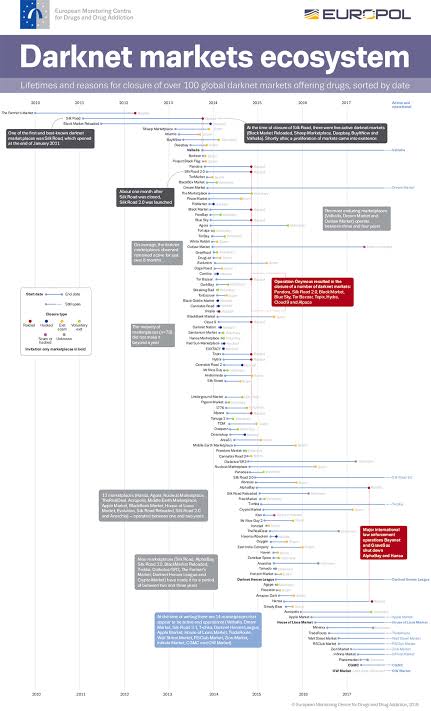
One defining characteristic of darknet marketplaces is instability. Throughout the history of darknet markets, platforms have frequently disappeared due to technical failures, operational decisions, security incidents, or law enforcement actions.
When a marketplace closes, vendors and users often migrate elsewhere. These migrations create new ecosystems while preserving many existing trust relationships. As a result, marketplace communities often survive beyond individual platforms. Europol research has also documented how repeated takedowns can shorten the lifecycle of criminal marketplaces and contribute to migration and fragmentation across the wider ecosystem.
This cycle has repeated numerous times. New markets emerge, establish reputations, attract users, and eventually face challenges. Meanwhile, participants adapt to changing conditions and continue seeking reliable platforms.
Market migration has therefore become a recurring theme within anonymous commerce research.
Technological Advances That Shaped Darknet Markets
Technology has continuously influenced marketplace evolution. Improvements in encryption, anonymous communication, and cryptocurrency infrastructure have expanded operational possibilities.
Search and discovery tools also became increasingly important. Users required reliable methods for locating hidden services and verifying marketplace accessibility. Consequently, indexing services and specialized search engines gained significance.
Additionally, link verification practices emerged as a response to impersonation attempts and fraudulent websites. Reliable access methods became increasingly important as hidden service ecosystems expanded. For more context, researchers can examine dark web link verification and the methods used to assess whether an onion address is authentic.
The growth of hidden-service ecosystems also created opportunities for impersonation and deceptive copies. These risks make fake onion links an important part of understanding how marketplace authenticity became a security concern over time.
The Modern Landscape and Research Significance
Today’s marketplace environment differs significantly from early implementations. Security practices have improved, reputation systems have matured, and operational models continue to evolve.
At the same time, researchers increasingly study these ecosystems to understand trust formation, digital governance, online anonymity, and decentralized reputation mechanisms.
The history of darknet markets provides valuable insight into how communities adapt when traditional institutions are absent. It also demonstrates how technology influences economic behavior within privacy-focused networks.
For cybersecurity professionals, these observations contribute to broader discussions about online trust, platform resilience, and digital risk management.
FAQ
What are darknet markets?
Darknet markets are online marketplaces accessible through anonymity-focused networks. They generally use hidden services and privacy-enhancing technologies. Researchers study them to understand anonymous commerce, trust systems, and digital communities.
When did darknet markets first appear?
Organized darknet marketplaces emerged during the late 2000s and early 2010s. Earlier anonymous trading communities existed before that period. However, structured marketplaces became more prominent after privacy technologies matured.
Why are reputation systems important?
Reputation systems help users evaluate trustworthiness in anonymous environments. Since traditional identity verification is often unavailable, participants rely on reviews, ratings, and transaction histories. These mechanisms reduce uncertainty and support marketplace activity.
How have darknet markets changed over time?
Marketplace structures have evolved significantly. Security practices improved, reputation systems became more sophisticated, and user expectations increased. Technological developments also influenced accessibility and operational models.
Why do researchers study darknet markets?
Researchers examine these ecosystems because they reveal how trust develops without traditional institutions. They also provide insight into anonymity networks, online communities, and digital governance models. Consequently, darknet marketplaces remain an important subject of academic and cybersecurity research.
Conclusion
The history of darknet markets demonstrates how anonymous online communities developed complex systems for trust, reputation, and commerce. From early hidden service experiments to sophisticated modern platforms, these marketplaces have continuously adapted to technological and operational challenges.
Although individual platforms frequently change, many underlying concepts remain consistent. Reputation, security, and community trust continue to shape participation. As a result, the history of darknet markets remains an important area of study for researchers seeking to understand digital anonymity, decentralized trust, and evolving online ecosystems.