
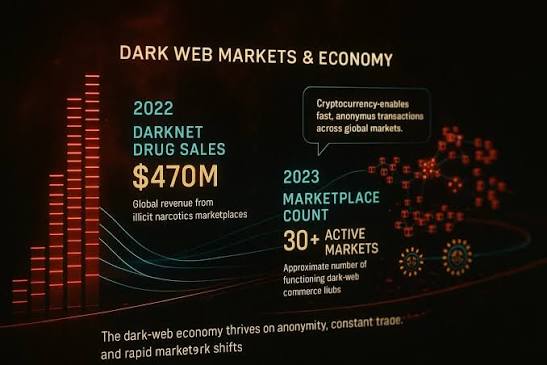
Introduction: Future of Darkweb Markets
The future of darkweb markets remains a topic of interest for researchers, cybersecurity analysts, journalists, and law enforcement agencies. Over the last decade, darknet marketplaces have experienced significant shifts due to enforcement actions, technological advancements, changing user behavior, and evolving security practices. As a result, understanding where these hidden ecosystems may be heading requires examining both historical patterns and emerging trends. To know better, please checkout the impact of darkweb domain seizures on future markets, future phases of the darknet market lifecycle and emerging dark web trends
While many early marketplaces relied on centralized infrastructure, newer platforms increasingly emphasize resilience, privacy, and trust mechanisms. At the same time, authorities continue improving investigative techniques, creating an ongoing cycle of adaptation and response. Consequently, market operators, researchers, and observers closely monitor developments in anonymity networks, cryptocurrency usage, and vendor reputation systems.
For more insight, please explore darknet markets overview.
Moreover, examining future developments helps explain how darknet communities evolve under pressure and how hidden services attempt to maintain continuity despite constant disruption.
The Evolution of Darknet Marketplaces
Darknet marketplaces have undergone several distinct phases since their emergence. Early platforms focused primarily on accessibility and anonymity. However, many lacked sophisticated security controls and often depended heavily on individual administrators. Consequently, successful law enforcement operations frequently disrupted entire ecosystems.
As market participants learned from previous failures, operators introduced stronger safeguards. Multi-signature transactions, decentralized communication channels, and improved escrow mechanisms became more common. These changes reflected a growing emphasis on reducing single points of failure. To know better, please see understanding darknet lifecycle risks
Furthermore, marketplace communities increasingly recognized the importance of trust. Vendor ratings, dispute resolution systems, and transaction histories evolved into essential components of marketplace design. Without these mechanisms, users struggled to distinguish reliable participants from fraudulent actors.
Technology also played a major role. Improvements in privacy-focused cryptocurrencies, secure messaging tools, and anonymity networks enabled marketplaces to operate with greater sophistication. Nevertheless, enhanced investigative capabilities created new challenges. Blockchain analysis, metadata collection, and international cooperation strengthened enforcement efforts against illicit online networks.
Today, researchers view marketplace development as an ongoing adaptation process rather than a static phenomenon. Operators seek new methods to reduce exposure, while investigators continue refining detection techniques. This dynamic environment shapes many predictions regarding the future direction of hidden online commerce.
To understand better, please review darknet market ecosystem analysis, future risks in darknet ecosystems and the future of new dark web marketplaces
Additionally, historical changes provide valuable context for understanding future transformations across darknet communities.
Technologies Shaping the Future of Darkweb Markets
Emerging technologies will likely influence the next generation of darknet marketplaces. Privacy-enhancing tools continue advancing, creating both opportunities and challenges for participants and researchers alike. For more insgight, please review how darknet market shutdowns shape future trends
One major area involves anonymity infrastructure. Improved routing technologies and enhanced hidden service architectures may strengthen operational resilience. At the same time, developers continue exploring methods to reduce surveillance risks and improve user privacy. Consequently, marketplaces may become more resistant to certain disruption techniques.
Cryptocurrency innovation represents another significant factor. Although Bitcoin remains widely recognized, many privacy-oriented alternatives have attracted attention due to enhanced transaction confidentiality. Future marketplace models may integrate multiple payment options while prioritizing financial privacy and fraud reduction.
Artificial intelligence could also influence darknet environments. Automated moderation systems, reputation analysis tools, and fraud-detection mechanisms may help communities identify suspicious behavior more effectively. However, researchers also expect investigative agencies to employ advanced analytics for threat intelligence and network monitoring.
Furthermore, distributed technologies could reduce dependence on centralized infrastructure. Some observers speculate that decentralized marketplace frameworks may emerge as alternatives to traditional administrator-controlled systems. Such approaches could potentially improve resilience but may introduce new governance challenges.
To see how it works, please explore onion search engine indexing methods.
For a deeper dive, please explore vendor reputation and trust indicators.
Ultimately, technological development will remain one of the most important drivers influencing how hidden online marketplaces evolve during the coming years.
Reputation Systems and Trust Mechanisms Will Become More Important
Trust has always been a critical factor in hidden online marketplaces. As platforms grow larger and more complex, reputation systems will likely become even more influential. Users often face uncertainty when interacting with anonymous participants. Therefore, transparent feedback mechanisms help reduce risk and improve decision-making.
A modern future of darkweb markets scenario depends heavily on accurate reputation tracking. Buyers typically evaluate transaction history, customer feedback, dispute outcomes, and account longevity before engaging with vendors. These indicators create a layer of accountability within otherwise anonymous environments.
Additionally, sophisticated reputation frameworks may evolve beyond simple rating systems. Future platforms could incorporate behavioral scoring, transaction consistency metrics, and fraud detection algorithms. Such systems may identify suspicious activity before significant damage occurs.
Another trend involves cross-platform credibility. Historically, vendor reputations often disappeared when a marketplace shut down. However, future systems may allow participants to maintain portable trust records across multiple communities. This approach could reduce the disruption caused by market closures and migrations.
Researchers also expect stronger verification procedures within marketplace ecosystems. Identity validation remains difficult in anonymous networks, yet communities continually seek ways to confirm authenticity without exposing sensitive information.
For more clarity, please see dark web link verification methods.
Likewise, identifying legitimate services remains essential for preserving trust. To explore further, please check verified onion resource directories.
As reputation mechanisms mature, they may become one of the defining characteristics of future darknet commerce. Without effective trust systems, marketplaces struggle to maintain stability, user confidence, and long-term participation.
Law Enforcement Pressure and Market Adaptation
Law enforcement activity has consistently shaped darknet marketplace development. Every major enforcement operation creates lessons that influence future platform design. Consequently, operators often modify infrastructure, communication methods, and security practices after significant disruptions.
International cooperation has expanded considerably during recent years. Agencies increasingly share intelligence, coordinate investigations, and analyze digital evidence across borders. This collaborative approach has contributed to the closure of numerous high-profile marketplaces.
As a result, platform operators continuously seek methods to improve resilience. Some focus on reducing centralized control, while others emphasize compartmentalization and operational security. Nevertheless, history shows that technological improvements alone rarely eliminate risk.
The relationship between enforcement efforts and marketplace evolution resembles an ongoing cycle. Investigators develop new techniques, marketplaces respond with adaptations, and researchers document the resulting changes. This process significantly influences predictions regarding the future of darkweb markets. For more insight, please explore international cybercrime operations.
Another important factor involves blockchain analytics. Cryptocurrency tracing tools have become more sophisticated, enabling investigators to uncover transaction patterns that were previously difficult to identify. Consequently, financial privacy remains a major area of focus for many communities operating within anonymity networks.
For additional knowledge, please read how fake onion resources affect user safety.
Researchers expect enforcement capabilities to continue improving. Therefore, future marketplaces must balance usability, security, trust, and resilience while facing increasingly advanced investigative techniques.
Decentralization, Security, and Future Challenges
Decentralization frequently appears in discussions about the long-term direction of darknet ecosystems. Many observers believe distributed architectures could reduce dependence on individual operators and centralized infrastructure. However, these systems introduce new complexities that require careful consideration.
One potential advantage involves resilience. Distributed platforms may continue functioning even when specific components become unavailable. Consequently, some developers view decentralized models as a way to address historical weaknesses associated with centralized marketplaces.
However, governance remains a major challenge. Traditional marketplaces often rely on administrators to resolve disputes and manage community standards. Decentralized environments may struggle to provide consistent oversight without introducing additional trust requirements.
Security concerns also continue evolving. Phishing attacks, cloned services, fraudulent listings, and impersonation campaigns remain persistent threats. Therefore, users increasingly seek reliable verification resources and independent research before interacting with unfamiliar platforms. For more knowledge, please visit digital privacy and security resources.
The future of darkweb markets will likely depend on how effectively communities address these challenges. Strong reputation systems, transparent verification practices, and resilient infrastructure may help improve overall reliability. Nevertheless, emerging threats will continue testing marketplace security models.
Researchers also anticipate greater attention to user education. Understanding common scams, recognizing suspicious behavior, and evaluating credibility indicators remain essential skills. As hidden services become more sophisticated, so do deception techniques designed to exploit inexperienced users.
To understand better, please review identifying suspicious dark web resources.
For more insights, please explore the changing landscape of darknet vendors.
Ultimately, future developments will depend on the balance between technological innovation, community trust, operational resilience, and external pressure. While predicting exact outcomes remains difficult, the broader direction suggests increasingly sophisticated ecosystems shaped by both opportunity and risk.
FAQ: Future of Darkweb Markets
1. What defines the future of darknet marketplaces?
The future of darknet marketplaces is shaped by technological change, enforcement pressure, and evolving user behavior. Over time, these platforms have shifted from simple centralized systems to more complex and adaptive ecosystems. As a result, researchers now focus on trends like decentralization, anonymity improvements, and trust frameworks. In addition, questions such as “how will darknet markets evolve,” “what replaces traditional hidden marketplaces,” and “are darknet ecosystems becoming more secure” are commonly explored. Ultimately, the direction of these markets depends on the balance between innovation and disruption.
2. How do reputation systems influence darknet market stability?
Reputation systems are one of the most important factors in maintaining marketplace stability. They help users evaluate vendors based on past transactions, feedback, and dispute outcomes. Without these systems, trust becomes significantly harder to establish in anonymous environments. Moreover, researchers often study “how darknet vendor ratings work” and “why trust scores matter in hidden markets.” In the context of the future of darkweb markets, reputation mechanisms are expected to become more advanced, possibly integrating behavioral analysis and cross-platform credibility tracking.
3. What role does cryptocurrency play in future darknet markets?
Cryptocurrency remains central to darknet market operations because it enables pseudonymous transactions. However, its role is evolving as analytics tools become more advanced. Investigators increasingly analyze blockchain data to identify suspicious patterns and trace illicit activity. Therefore, users and researchers often ask “how secure are crypto payments in darknet markets” and “will privacy coins replace Bitcoin in hidden ecosystems.” As a result, future systems may adopt multi-layered financial privacy tools to reduce exposure and improve transaction confidentiality.
4. Will decentralization make darknet markets more secure?
Decentralization may improve resilience by reducing reliance on single points of failure. However, it does not automatically guarantee security or trust. Instead, it introduces new challenges such as governance disputes, fraud detection, and coordination issues. Many studies explore “can decentralized darknet platforms survive enforcement pressure” and “do distributed marketplaces reduce shutdown risks.” In the broader future of darkweb markets, decentralization is seen as both an opportunity and a technical challenge that must be carefully balanced.
5. How does law enforcement affect darknet market evolution?
Law enforcement has a significant impact on how darknet markets evolve over time. Each major takedown leads to design changes, improved security features, and altered operational strategies. Consequently, platforms adapt by strengthening anonymity, improving infrastructure, and refining trust systems. Common user queries include “how are darknet markets shut down,” “what happens after a marketplace takedown,” and “how do operators avoid detection.” Overall, enforcement pressure continues to shape the long-term development of hidden online ecosystems.
Conclusion: Future of Darkweb Markets
The future of darkweb markets is defined by constant adaptation, where innovation and enforcement evolve side by side. Over time, marketplaces have become more structured, more cautious, and more technologically advanced. At the same time, they face increasing pressure from global investigative efforts and improved digital tracing tools.
As trends continue, reputation systems, decentralization, and privacy-enhancing technologies will likely play a larger role. However, these developments also introduce new challenges involving governance, fraud prevention, and user safety. Therefore, understanding these dynamics is essential for researchers studying hidden digital ecosystems.
In summary, the evolution of darknet marketplaces reflects a continuous cycle of change, where stability is temporary and adaptation is constant. The future of darkweb markets will likely remain complex, shaped by both technological progress and external intervention.