
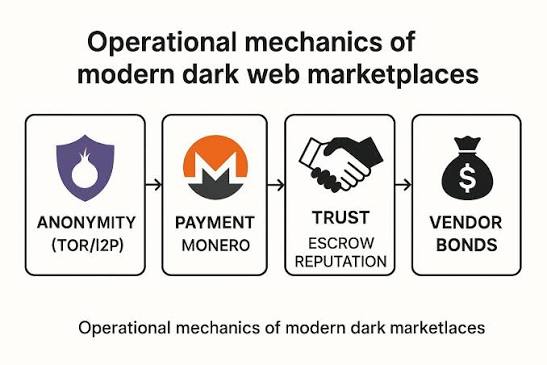
Introduction: Darknet Market Reputation System
Trust is difficult to establish in anonymous online environments. Unlike traditional e-commerce platforms, darknet marketplaces often operate without formal consumer protections, verified identities, or centralized dispute resolution systems. As a result, users frequently rely on a darknet market reputation system to evaluate vendors, assess transaction reliability, and reduce potential risks.
These reputation mechanisms have evolved over time. While they differ between marketplaces, most use a combination of vendor ratings, buyer feedback, escrow performance, dispute history, and account longevity. Consequently, reputation often becomes one of the most influential factors when users assess marketplace participants. These mechanisms also connect closely with darkweb vendor trust, because reputation signals influence how researchers understand credibility in anonymous vendor environments.
Researchers studying underground economies frequently examine these systems because they reveal how trust emerges in environments where anonymity remains a priority. Understanding these mechanisms also helps explain why some vendors gain long-term credibility while others disappear quickly.
For more insight into darknet markets, explore the broader marketplace ecosystem and the systems that shape vendor reputation, trust, and user confidence.
How Reputation Systems Emerged in Darknet Markets
Early darknet marketplaces faced a major challenge. Buyers had limited ways to determine whether a vendor was reliable. Since participants rarely revealed their real identities, traditional trust signals were absent. The differences between centralized marketplaces and independent shops also affect how reputation develops, making vendor shops and darknet markets an important comparison when studying anonymous trust systems.
To address this problem, marketplace operators began implementing feedback systems similar to those found on conventional e-commerce platforms. Buyers could leave reviews after completed transactions, creating a record of vendor performance over time.
As marketplaces matured, reputation models became more sophisticated. Instead of relying solely on star ratings, many platforms incorporated transaction volume, account age, dispute frequency, and successful delivery records. These metrics created a broader picture of vendor reliability.
A modern darknet market reputation system often functions as a trust layer. Rather than guaranteeing legitimacy, it provides indicators that users can evaluate before making decisions. Therefore, reputation becomes a form of social proof within anonymous communities.
Researchers analyzing underground commerce frequently compare these mechanisms to trust-building systems used by mainstream marketplaces. Although the environments differ significantly, both rely on accumulated user experiences to signal reliability.
To understand better, please review darknet marketplace structures and how reputation systems evolve across anonymous online markets.
Key Components of a Darknet Market Reputation System
Several elements typically contribute to reputation scoring across marketplaces.
Vendor Feedback
Feedback remains one of the most visible indicators. Buyers often leave comments regarding communication quality, transaction completion, and overall experience. Positive reviews generally strengthen perceived credibility, while repeated complaints can damage trust.
Transaction History
Many marketplaces display completed transaction counts. High transaction volumes may indicate operational consistency. However, researchers caution against relying solely on volume because quantity does not always reflect quality.
Account Longevity
Long-standing vendor accounts often receive greater trust from marketplace participants. A vendor operating successfully for several years typically appears more reliable than a newly created profile.
Dispute Resolution Records
Disputes offer valuable insight into vendor behavior. Markets that maintain transparent dispute histories allow users to assess how conflicts were handled and whether recurring issues exist.
Escrow Performance
Escrow mechanisms play an important role in many marketplaces. Vendors who consistently complete escrow transactions without complaints often benefit from stronger reputational standing.
Together, these indicators form the foundation of a darknet market reputation system, helping users evaluate risk in anonymous environments.
To get more context, please explore the broader darknet market lifecycle, including how marketplace development, reputation, stability, and decline can influence trust over time.
Why Reputation Does Not Always Equal Trustworthiness
Although reputation systems provide useful signals, they have important limitations. Users and researchers should avoid treating ratings as guarantees.
One major concern involves manipulated reviews. Vendors may attempt to inflate ratings through coordinated activity or fabricated transactions. Consequently, positive feedback alone may not accurately reflect reliability. These problems also show why researchers should consider fake onion links and impersonation techniques when evaluating whether online identities and reputation signals are genuine.
Another issue involves market migration. When marketplaces close unexpectedly, vendors often move to new platforms. During these transitions, historical reputation data may become fragmented or difficult to verify.
Additionally, account compromise can create misleading trust signals. A previously respected vendor profile may change ownership or experience unauthorized access. As a result, reputation scores may no longer reflect current behavior. for ore insight, please explore online anonymity and security best practices
Market operators also vary in transparency. Some platforms provide detailed metrics, while others disclose very little information. Therefore, reputation systems differ considerably across ecosystems.
Researchers examining underground commerce often emphasize contextual analysis. Rather than relying on a single metric, they evaluate multiple trust indicators simultaneously. This broader approach generally provides a more accurate understanding of marketplace dynamics.
Reputation, Vendor Verification, and Marketplace Survival
Marketplace survival often depends on user confidence. When trust declines, activity typically decreases. Consequently, operators frequently invest significant effort in maintaining reputation frameworks.
Vendor verification programs represent one example. Some marketplaces establish additional review procedures before granting enhanced status or special badges. These measures aim to reduce uncertainty and encourage user participation.
Community forums also contribute to trust development. Discussions about vendor experiences, transaction outcomes, and marketplace performance create informal layers of reputation beyond official scoring systems.
Moreover, independent verification resources sometimes help researchers assess marketplace claims. Comparing vendor histories across multiple sources may reveal inconsistencies that platform ratings alone fail to capture.
To learn more about this, please explore dark web link verification methods when assessing whether marketplace information and related online references can be independently validated.
The relationship between reputation and marketplace stability remains significant. Strong trust signals can attract participation, whereas persistent credibility concerns often accelerate platform decline. These dynamics also matter when researchers examine darkweb vendor shops, where independent operators may rely on reputation and verification signals without the same centralized systems found on larger marketplaces.
The Research Value of Reputation Systems
Academic researchers, cybersecurity analysts, and investigative journalists frequently study reputation systems because they provide insight into digital trust formation.
These environments function as natural experiments. Participants must develop mechanisms for evaluating credibility despite anonymity and limited oversight. Therefore, reputation data can reveal broader patterns of human behavior in online communities. Researchers can also place these patterns in the broader history of darknet markets, where changing platforms and marketplace structures have influenced how reputation develops.
Studies often examine review inflation, trust signaling, vendor migration, and dispute resolution outcomes. Such research helps explain how decentralized trust networks evolve over time. To understand better, please visit research on hidden services and anonymity networks
A darknet market reputation system also illustrates the limitations of reputation-based governance. While feedback mechanisms improve information sharing, they cannot eliminate uncertainty entirely.
Furthermore, these systems highlight the ongoing tension between anonymity and accountability. Participants seek privacy while simultaneously requiring trust indicators. Reputation frameworks emerge as a practical compromise between those competing objectives.
FAQ: Darknet Market Reputation System
What is a darknet market reputation system?
A darknet market reputation system is a framework that helps users evaluate vendors through ratings, reviews, transaction histories, and dispute records. It functions as a trust mechanism within anonymous marketplaces. Because participants often remain unidentified, reputation data becomes an important decision-making tool. However, it should be viewed as an indicator rather than proof of reliability.
Why do darknet marketplaces use reputation scores?
Reputation scores help reduce uncertainty between buyers and vendors. Without traditional identity verification, marketplaces need alternative methods for establishing credibility. Feedback systems encourage accountability and provide historical performance records. Consequently, users gain additional information before engaging with vendors.
Can vendor reviews be manipulated?
Yes. Review manipulation remains a known challenge across many online platforms. Some vendors may attempt to create artificial feedback or coordinate favorable reviews. Therefore, researchers recommend examining multiple trust indicators rather than relying exclusively on ratings.
How does escrow affect vendor reputation?
Escrow systems hold funds until transaction conditions are met. Vendors who consistently complete escrow transactions without disputes often build stronger reputational profiles. Successful escrow histories can signal operational reliability. Nevertheless, escrow performance should be evaluated alongside other metrics.
Why is account age important in reputation analysis?
Longer account histories often suggest consistency and continued participation. Users may perceive established accounts as less risky than newly created profiles. However, age alone does not guarantee trustworthiness. Analysts typically combine account longevity with review quality, transaction volume, and dispute outcomes.
Conclusion: Darknet Market Reputation System
Trust remains one of the most important challenges within anonymous online marketplaces. As a result, the darknet market reputation system has become a central mechanism for evaluating vendor reliability, transaction consistency, and marketplace credibility.
Although reputation scores, reviews, and escrow histories provide valuable insights, they also have limitations. Researchers continue to study these systems because they reveal how trust develops when traditional verification methods are unavailable. Ultimately, understanding reputation frameworks offers a clearer view of marketplace behavior, risk assessment, and the broader dynamics of anonymous digital communities.