
Introduction: Darknet Market Lifecycle
The study of underground digital economies has expanded significantly over the past decade, particularly as researchers seek to understand how anonymous marketplaces emerge, grow, and eventually disappear. The darknet market lifecycle provides a useful framework for analyzing these patterns, revealing how technical infrastructure, user trust, security practices, and law enforcement pressure interact over time.
Although individual platforms differ substantially, most darknet marketplaces exhibit recognizable developmental stages. These stages often include initial launch periods, community expansion, operational maturity, heightened security challenges, and eventual decline or disruption. Consequently, examining marketplace lifecycles helps researchers better understand the broader evolution of anonymous commerce ecosystems.
Moreover, the rise and fall of major platforms have generated valuable insights into trust mechanisms, reputation systems, operational security, and criminal network adaptation. These observations continue to shape contemporary darknet research and cybersecurity analysis.
For more insight, please explore dark web search engines overview.
The Formation Stage of the Darknet Market Lifecycle
The earliest stage of the darknet market lifecycle typically begins when operators identify a perceived gap within existing underground ecosystems. Market administrators often attempt to differentiate their platforms through improved security models, specialized product categories, lower commission structures, or enhanced anonymity features.
During this initial phase, operators face significant challenges related to trust establishment. Since newly launched marketplaces lack transaction histories and user reputations, administrators frequently invest substantial effort in community engagement, technical development, and vendor recruitment. Reputation, therefore, becomes one of the most valuable assets during marketplace formation. This makes darkweb vendor trust an important factor when researchers examine how credibility develops during the early stages of an anonymous marketplace.
Additionally, technical infrastructure plays a critical role in early market survival. Administrators must manage hidden service hosting environments, cryptocurrency payment systems, escrow mechanisms, and anti-fraud protections. Even minor operational failures can rapidly damage credibility among early adopters.
The formation period also attracts researchers because it reveals how anonymous communities develop trust under conditions of uncertainty. Market operators often borrow successful strategies from previous platforms while attempting to avoid historical vulnerabilities.
Growth, Expansion, and Community Development
After surviving the initial launch period, marketplaces typically enter a phase characterized by rapid expansion and increasing operational complexity. During this stage, user populations grow, vendor participation expands, and transaction volumes often increase substantially.
The growth phase of the darknet market lifecycle depends heavily on trust mechanisms. Vendor reputation systems, customer reviews, dispute resolution procedures, and escrow services collectively create an environment where anonymous participants can establish credibility over time. Without these mechanisms, marketplace stability becomes difficult to maintain. Researchers examining these mechanisms can also explore darknet market reputation systems to understand how feedback and reputation signals influence marketplace behavior.
Furthermore, successful markets frequently diversify their offerings beyond their original focus areas. Some platforms expand into digital services, fraud-related products, or specialized categories designed to attract niche communities. This diversification strategy may increase market resilience, although it also introduces additional operational risks.
Competition also intensifies during expansion periods. New entrants regularly attempt to replicate successful models while offering lower fees or improved security features. Consequently, established marketplaces continuously adapt to maintain their user base and market position.
Researchers studying anonymous economies often view this stage as the most dynamic period of marketplace evolution because behavioral patterns, governance structures, and technological innovations develop simultaneously.
For additional context regarding vendor ecosystems, please review darkweb vendor shops.
Operational Maturity and Stabilization Phase
Once a marketplace survives initial expansion, it typically enters a more structured and stable phase of the darknet market lifecycle. At this point, systems become more standardized, and operational routines are established to handle increasing transaction volume and user expectations. Platform administrators often refine escrow mechanisms, dispute resolution protocols, and vendor onboarding procedures to reduce friction. These developments are also useful when examining broader darknet marketplaces, where different governance and operational structures can produce different patterns of growth and stability.
During this stage, reliability becomes a core competitive factor. Users tend to prioritize platforms with consistent uptime, predictable transaction handling, and established vendor reputations. As a result, marketplaces often shift focus from rapid expansion to maintaining operational continuity. However, this stability is frequently fragile, as underlying anonymity constraints limit transparency and accountability.
In many cases, markets introduce layered security improvements such as multi-signature wallets or enhanced encryption channels. These features are designed to reduce fraud risks and increase user confidence. Nevertheless, even mature platforms remain vulnerable to internal corruption, technical failures, or external disruptions.
Security Pressures, Exit Scams, and Trust Breakdown
As marketplaces mature, they often face increased security pressure from both internal and external sources. Internal risks may include vendor fraud, administrator misconduct, or compromised escrow systems. External pressures often stem from law enforcement monitoring and cybersecurity investigations targeting infrastructure weaknesses.
A major turning point in the darknet market lifecycle occurs when trust begins to erode. Even well-established platforms can collapse rapidly if users suspect manipulation or mismanagement of funds. This phenomenon is commonly associated with exit scams, where administrators abruptly shut down operations and retain user-held assets. Comparing darkweb vendor shops vs markets can provide additional context for understanding how different organizational models respond to trust failures, disruption, and changes in user confidence.
Trust breakdown typically spreads quickly through underground communities. Since reputation systems rely heavily on user-generated feedback, negative reports can significantly accelerate user migration to alternative platforms. This dynamic highlights the fragile nature of trust in anonymous ecosystems.
Additionally, external disruptions such as server seizures or infiltration operations can destabilize even high-traffic marketplaces. Historical patterns show that once confidence declines, recovery is extremely difficult, even if the platform resumes operations.
Decline, Fragmentation, and Market Replacement
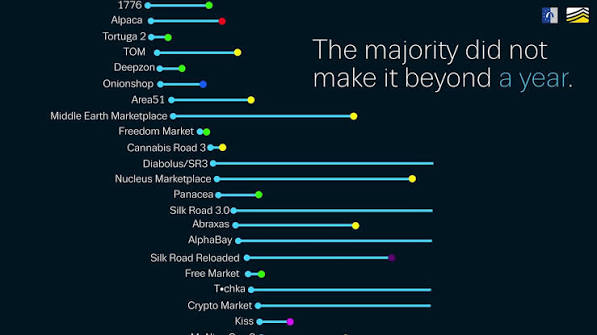
After trust deterioration or external disruption, marketplaces typically enter the decline phase of the lifecycle. During this stage, user activity decreases, vendors migrate to competing platforms, and transaction volumes drop significantly. Fragmentation often follows, with smaller successor markets emerging to fill the void. These recurring patterns become clearer when viewed alongside the history of darknet markets, where previous cycles of closure, migration, and replacement provide useful historical context.
The decline phase of the darknet market lifecycle is rarely linear. Instead, it is marked by instability, rapid shifts in user behavior, and frequent platform replacements. Even when a dominant marketplace collapses, its infrastructure model and vendor networks often reappear in modified forms elsewhere.
Law enforcement pressure plays a critical role in accelerating this decline. Coordinated international actions, infrastructure takedowns, and financial tracing techniques can severely disrupt operational continuity. However, historical trends show that new marketplaces often emerge shortly after closures, reflecting adaptive resilience within these ecosystems. When researchers encounter old marketplace references, migrated services, or replacement addresses, dark web link verification can help determine whether the infrastructure being referenced is authentic. At the same time, researchers must distinguish legitimate successor services from deceptive copies, making fake onion links and impersonation techniques an important consideration when studying marketplace replacement and migration.
At this stage, user trust is typically fragmented across multiple smaller platforms rather than concentrated in a single dominant marketplace. This fragmentation reduces overall efficiency but increases redundancy within the system.
External Authority Sources and Research References
Understanding the darknet market lifecycle requires more than observational data from marketplace behavior. External cybersecurity organizations and research institutions provide critical context on infrastructure risks, enforcement trends, and anonymity technologies.
For example, Europol has repeatedly published reports detailing how illicit marketplaces evolve and how enforcement actions disrupt their operational continuity. These insights help explain why many markets fail during their maturity phase rather than their growth phase.
For more insight, please explore Europol cybercrime reports and darknet enforcement analysis.
The Tor Project also remains a foundational reference for understanding anonymity infrastructure. Since most darknet markets rely on onion routing, the technical stability and limitations of Tor directly influence marketplace survival and accessibility.
For more insight, please explore Tor Project documentation on onion services and network privacy.
In addition, the Electronic Frontier Foundation (EFF) provides important analysis on privacy rights, surveillance limitations, and encryption technologies. These concepts are essential when evaluating how markets attempt to maintain operational secrecy while facing increasing external pressure.
For more insight, please explore EFF digital privacy and encryption research.
Finally, cybersecurity reporting platforms such as BleepingComputer frequently document real-world incidents involving marketplace takedowns, ransomware ecosystems, and infrastructure breaches. These case studies help illustrate how collapse events occur in practice.
For more insight, please explore BleepingComputer cybersecurity news and investigations.
FAQ: Darknet Market Lifecycle
1. What defines the darknet market lifecycle?
The darknet market lifecycle describes how anonymous online marketplaces evolve from creation to decline. It is generally structured into stages such as formation, growth, maturity, and collapse. Each stage reflects changes in user trust, technical stability, and security pressure. Researchers use this model to understand how underground digital economies develop and adapt over time.
2. Why do darknet marketplaces grow so quickly at first?
Early growth is often driven by novelty, limited competition, and aggressive vendor recruitment. During this stage, platforms focus on building trust systems such as escrow services and reputation ratings. As a result, user adoption can increase rapidly when early operations appear stable. However, this growth phase remains fragile due to technical vulnerabilities and limited historical credibility.
3. What causes a darknet marketplace to collapse?
Several factors can contribute to collapse, including law enforcement interventions, internal fraud, or exit scams. In many cases, the breakdown of trust accelerates the failure more than external pressure alone. Once users lose confidence in a platform, migration to alternative marketplaces happens quickly. Consequently, even large platforms can disappear with little warning.
4. How do exit scams affect the lifecycle of these markets?
Exit scams represent one of the most disruptive events in the lifecycle. In such cases, administrators shut down operations and retain user funds. This event typically occurs during or after the maturity phase when transaction volumes are high. After an exit scam, trust across the ecosystem is significantly weakened, affecting even unrelated marketplaces.
5. Do darknet markets ever recover after decline?
Recovery is rare but not impossible. Some platforms rebrand or relaunch under new infrastructure after shutdowns. However, user trust is usually difficult to rebuild, especially after major disruptions. As a result, most markets that enter a decline phase are replaced rather than restored.
Conclusion: Darknet Market Lifecycle
The darknet market lifecycle illustrates how anonymous digital marketplaces follow predictable yet unstable developmental patterns. From formation and rapid growth to maturity and eventual decline, each phase reflects shifting dynamics of trust, technology, and enforcement pressure.
Although these platforms often appear resilient, their long-term stability remains limited by structural vulnerabilities and reliance on anonymity. As a result, cycles of emergence and collapse continue to define the ecosystem.
Understanding the lifecycle provides valuable insight into how underground markets adapt, fragment, and reappear over time. It also highlights the importance of trust mechanisms and security constraints in shaping digital economies.
Ultimately, analyzing the darknet market lifecycle helps researchers interpret broader trends in decentralized online systems and their ongoing evolution.