
Introduction: Dark Web Data Leak
The unauthorized exposure of personal, corporate, and government information has become a major cybersecurity concern worldwide. A dark web data leak often refers to stolen or compromised information that appears on hidden services, underground forums, or anonymous marketplaces operating through privacy-focused networks. Researchers, cybersecurity analysts, and threat intelligence teams actively monitor these environments to identify emerging risks and understand how leaked information circulates. To understand the wider consequences of exposed information, please explore cybersecurity risks associated with dark web activity, which examines how stolen data, malicious infrastructure, and underground activity can create broader security threats.
Data exposures can originate from ransomware incidents, credential theft campaigns, supply chain attacks, insider threats, or large-scale database compromises. Once exposed information enters underground ecosystems, it frequently becomes part of broader criminal operations involving fraud, account takeovers, identity theft, and financial crime.
To understand how researchers locate hidden services and monitor underground activity, please review dark web risks.
Understanding these ecosystems provides valuable insight into cybercriminal behavior, threat intelligence methodologies, digital privacy challenges, and modern cybersecurity defense strategies.
How Dark Web Data Leaks Enter Underground Ecosystems
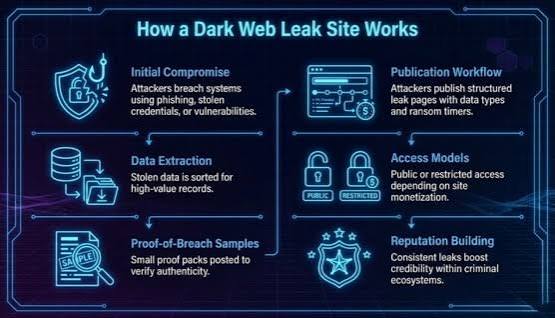
The journey from a security breach to underground distribution often involves multiple stages. Initially, attackers obtain sensitive information through phishing attacks, malware infections, compromised credentials, software vulnerabilities, or insider access. Once acquired, this information may circulate through private communities, criminal forums, and other restricted online channels. As datasets are copied, repackaged, and redistributed, the original breach can create risks that continue long after the initial compromise.
One of the most significant characteristics of a dark web data leak is the speed at which compromised information can spread across multiple platforms. Data brokers, cybercriminal groups, and fraud operators regularly exchange stolen records through encrypted channels, invitation-only forums, and anonymous marketplaces.
Researchers have observed that leaked information often includes login credentials, financial records, healthcare data, intellectual property, business documents, and personally identifiable information. Additionally, threat actors frequently combine datasets from multiple breaches to create more valuable criminal products.
Furthermore, investigators continue studying how underground communities establish trust through reputation systems, private referrals, and transaction verification mechanisms.
These observations help cybersecurity professionals understand not only how breaches occur, but also how stolen information evolves into long-term criminal assets.
Common Types of Information Found in Data Exposure Markets
Cybersecurity researchers classify underground data exposure markets according to the type and value of compromised information being traded. Financial information remains highly sought after because it enables direct monetary exploitation. However, identity documents, healthcare records, and corporate intelligence have also become increasingly valuable.
Another important aspect of modern dark web data leak investigations involves credential marketplaces. These platforms often distribute usernames, passwords, authentication tokens, session cookies, and compromised enterprise access credentials. Such information may facilitate account takeover attacks, corporate espionage, or unauthorized system access.
Researchers have also documented growing markets for organizational data obtained through ransomware operations. Threat actors frequently publish or auction internal company documents, proprietary research, employee records, and confidential communications after successful compromises.
Additionally, cybersecurity teams increasingly monitor hidden services for indicators of credential stuffing campaigns, business email compromise operations, and identity fraud networks.
Cybersecurity teams also examine changes in infrastructure and online activity to identify patterns associated with compromised information. For more context, please explore dark web tracking methods, which examines how researchers analyze changing infrastructure and behavioral patterns across hidden online environments.
The commercialization of stolen information demonstrates how cybercrime ecosystems have evolved into highly organized digital marketplaces. Consequently, threat intelligence monitoring remains a critical component of modern cybersecurity operations.
Threat Intelligence and Monitoring of Underground Data Markets
Cybersecurity organizations increasingly rely on threat intelligence operations to identify and analyze compromised information circulating across anonymous networks. Monitoring hidden services allows researchers to detect emerging attack campaigns, identify breached organizations, and assess potential downstream risks before they become more widespread.
One of the most important aspects of monitoring a dark web data leak involves correlating exposed information with known attack patterns. Threat analysts examine timestamps, user activity, marketplace behavior, ransomware communications, and credential distribution channels to determine the origin and potential impact of leaked datasets.
Researchers also employ open-source intelligence techniques, automated monitoring tools, behavioral analysis, and digital forensics to investigate underground ecosystems. These methods help organizations identify compromised accounts, track criminal infrastructure, and improve incident response capabilities.
Threat intelligence monitoring requires researchers to evaluate information carefully, correlate multiple indicators, and distinguish credible evidence from misleading or incomplete data. This helps organizations identify exposure risks without relying on a single source or isolated indicator.
Threat intelligence monitoring also assists organizations in evaluating supply chain risks, credential exposure events, and ransomware extortion campaigns. Consequently, many enterprises now incorporate dark web monitoring into their broader cybersecurity strategies.
Criminal Business Models and Data Commercialization
The commercialization of stolen information represents one of the most significant developments within underground cybercrime ecosystems. Rather than operating independently, many threat actors participate in complex criminal marketplaces where specialized services are bought, sold, and exchanged.
Another major characteristic of contemporary dark web data leak operations involves the emergence of data brokerage networks. These networks aggregate compromised information from multiple breaches and package datasets according to industry, geography, or data type. Buyers may then use this information for fraud, extortion, credential stuffing, phishing campaigns, or identity theft operations.
Compromised information can also support follow-up fraud campaigns, particularly when attackers use exposed credentials or personal details to create convincing impersonation attempts. For a broader examination of these social engineering risks, please explore phishing on the darknet.
Researchers have also documented the growing role of ransomware groups in underground data markets. Rather than relying solely on encryption-based extortion, many groups now publish stolen information through dedicated leak platforms to increase pressure on victims.
The movement of stolen information between different criminal groups demonstrates how specialized cybercrime operations can become interconnected. Data theft, fraud, phishing, ransomware, and identity abuse may operate as separate activities while still relying on the same pools of compromised information.
Researchers continue studying how marketplace closures, enforcement actions, and operational failures influence criminal migration patterns across anonymous ecosystems. These observations provide valuable insight into the resilience and adaptability of cybercrime networks.
Law Enforcement Responses and Cybersecurity Investigations
International law enforcement agencies have significantly expanded their efforts to combat cybercrime operations involving data theft, ransomware, identity fraud, and underground marketplaces. Through international cooperation, digital forensics advancements, and blockchain analysis capabilities, investigators have successfully disrupted numerous criminal networks.
The investigation of a dark web data leak often requires cooperation among multiple organizations, including law enforcement agencies, cybersecurity firms, financial institutions, and threat intelligence providers. Investigators analyze server infrastructure, financial transactions, operational security failures, and digital evidence to identify responsible actors.
Researchers have found that operational mistakes remain one of the most common reasons criminal networks become exposed. Infrastructure reuse, inadequate compartmentalization, poor anonymity practices, and communication errors frequently contribute to successful investigations.
Additionally, infrastructure seizures continue influencing the operational strategies used by underground communities.
Infrastructure disruption and coordinated investigations can temporarily reduce criminal activity, but threat actors often adapt by changing communication channels, identities, or technical infrastructure. This makes long-term monitoring and information sharing important parts of cybersecurity defense.
As investigative capabilities continue improving, cybercriminal organizations increasingly adopt more sophisticated operational security measures. This ongoing adaptation creates a dynamic environment that remains a major focus of cybersecurity research and law enforcement analysis.
Trusted Authority References: Dark Web Data Leak
Europol: Cybercrime Threat Intelligence
Europol publishes strategic assessments, operational reports, and intelligence analyses related to cybercrime, ransomware, online fraud, and underground criminal ecosystems. These resources provide valuable context for understanding the global impact of data breaches and cybercriminal operations.
For more insight, please explore Europol cybercrime investigations.
Electronic Frontier Foundation: Privacy and Security Resources
The Electronic Frontier Foundation provides educational resources related to digital privacy, cybersecurity, encryption technologies, and online rights. Researchers frequently reference these materials when evaluating privacy technologies and cybersecurity risks.
For additional knowledge, please explore EFF privacy and security resources.
BleepingComputer: Cybersecurity Incident Reporting
BleepingComputer regularly reports on ransomware campaigns, major data breaches, cybercrime investigations, vulnerability disclosures, and emerging cybersecurity threats. These reports provide timely insight into current cyber threat landscapes.
For further information, please refer to BleepingComputer cybersecurity coverage.
FAQ: Dark Web Data Leak
What is a dark web data leak?
A dark web data leak refers to the unauthorized exposure and distribution of sensitive information through hidden services and underground marketplaces. These leaks often include login credentials, financial records, personal identification data, healthcare information, and corporate documents. Criminal groups frequently obtain this information through phishing campaigns, malware infections, insider threats, or direct breaches of company databases. As a result, organizations and individuals face significant financial and privacy risks.
How do cybercriminals profit from leaked data?
Cybercriminals monetize stolen information in several ways. They may sell credentials directly through darknet marketplaces, bundle large databases for auction, or use the data for identity theft and financial fraud. Additionally, ransomware groups increasingly employ double-extortion tactics, where attackers encrypt systems and simultaneously threaten to release stolen information publicly. Consequently, a single data breach can generate multiple revenue streams for threat actors.
Are dark web data leaks increasing?
Security researchers and law enforcement agencies continue to report growth in underground data trading activity. While some major marketplaces have been disrupted, new platforms regularly emerge to replace them. Furthermore, the expansion of ransomware-as-a-service ecosystems has accelerated the circulation of stolen information. Therefore, cybersecurity experts generally consider dark web exposure risks to remain elevated.
How can organizations identify if their data appears on the dark web?
Organizations typically rely on threat intelligence services, breach monitoring platforms, and digital risk protection tools to detect leaked information. Security teams also monitor underground forums, credential markets, and data-sharing channels for references to their organization. Early detection enables companies to rotate credentials, notify affected users, and initiate incident response procedures more effectively. Regular monitoring significantly reduces long-term damage.
What steps can individuals take after discovering a data leak?
Individuals should immediately change affected passwords and enable multi-factor authentication wherever possible. They should also monitor financial accounts, review credit reports, and watch for suspicious activity. In cases involving identity documents or financial information, contacting relevant institutions quickly is essential. Moreover, ongoing vigilance remains important because stolen information may circulate for months or even years.
Conclusion: Dark Web Data Leak
Understanding dark web data leak activity has become increasingly important for cybersecurity professionals, businesses, and individual users. Modern data breaches rarely end with initial system compromise; instead, stolen information often enters complex underground ecosystems where criminals trade, exploit, and redistribute sensitive records. Consequently, organizations must adopt proactive monitoring strategies, strengthen access controls, and invest in incident response preparedness.
Organizations and individuals can reduce the long-term impact of data exposure by improving account security, monitoring suspicious activity, and maintaining awareness of common online threats. For broader defensive guidance, please explore darkweb safety tips
At the same time, individuals should remain aware of emerging cyber threats, protect their accounts, and remain cautious of follow-up fraud attempts that can occur after compromised information begins circulating.. As underground marketplaces evolve and threat actors develop new monetization strategies, awareness and prevention remain the most effective defenses against long-term exposure and financial harm