
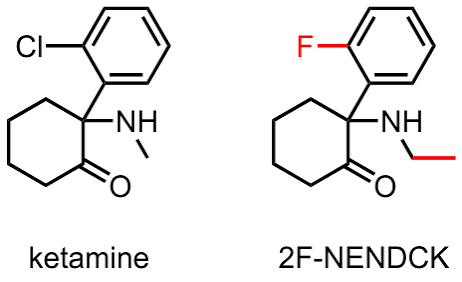
Ketamine is an established dissociative anesthetic, but the growing discussion around ketamine analogs involves a wider and less predictable group of substances. Some are chemically related to ketamine, while others are discussed alongside it because of similar dissociative effects. However, similarity does not mean identical pharmacology, safety, or duration. For researchers and the public, the central challenge is understanding where evidence ends and assumptions begin.
For more insight, please explore drug awareness overview.
What Are Ketamine Analogs?
Ketamine analogs are substances that are chemically related to ketamine or share parts of its broader pharmacological profile. Many are associated with the arylcyclohexylamine family, which includes compounds developed for scientific research as well as substances that later appeared in novel psychoactive substance monitoring.To understand better, please checkout PCP analogs and related dissociatives
A small structural change can create meaningful differences. Depending on the compound, researchers may observe changes in onset, duration, receptor activity, metabolism, or subjective effects. Therefore, describing an unfamiliar compound as “just like ketamine” can hide important scientific uncertainty.
The term also appears in several search contexts. People may search for “what are ketamine analogs,” “ketamine-like drugs,” “new dissociative drugs,” or “arylcyclohexylamine risks.” These searches reflect a need for definitions rather than simple product comparisons.
A practical definition
A ketamine-related analog is not automatically:
- A medically approved medicine
- Safe because pharmaceutical ketamine has clinical uses
- Equal to ketamine in strength or duration
- Legal in every jurisdiction
- Reliably identified by an online label
Instead, each compound should be evaluated individually. Its chemical identity, available research, toxicology, and legal status all matter.
How Ketamine Analogs Affect the Brain
Many ketamine analogs are discussed as dissociatives because they may alter perception, consciousness, sensory processing, memory, and the sense of connection with the surrounding environment. The experience can range from mild detachment to profound disorientation, depending on the specific compound and other factors.
A key mechanism associated with ketamine and several related substances is NMDA receptor antagonism. NMDA receptors are involved in excitatory signaling and processes related to learning and memory. Still, receptor activity alone cannot predict the complete effect profile of a particular compound.
Some substances may also interact with additional receptors or produce active metabolites. Consequently, two compounds with broadly similar structures can produce different physiological and psychological outcomes. The evidence available for one should not automatically be applied to another.
Why Ketamine Analogs Are Difficult to Study
The scientific evidence surrounding ketamine analogs varies dramatically. Pharmaceutical ketamine has a much larger research base than many newer compounds. By contrast, some emerging dissociatives may have limited laboratory studies, isolated toxicology findings, or almost no controlled human research.
This creates a substantial evidence gap. Researchers may not know a compound’s long-term effects, toxic dose range, interaction profile, or full metabolic pathway. Emergency clinicians may also encounter cases involving substances for which standard information is incomplete.
For additional knowledge, please read research chemical safety.
Uncertainty is especially important when substances are discussed under multiple names. Chemical identifiers, abbreviations, slang, and commercial descriptions can change rapidly. Therefore, reliable research requires separating a confirmed chemical identity from a name used in an unverified listing.
Commonly Discussed Ketamine Analogs and Related Dissociatives
Some ketamine-related compounds are discussed in forensic reports, toxicology literature, and broader conversations about novel psychoactive substances. Examples may include methoxetamine and dissociative arylcyclohexylamines such as 2-FDCK, DCK, and DMXE.
However, these compounds should not be treated as interchangeable. A name from the same chemical family does not establish the same potency, duration, adverse effects, or interaction risks. The scientific evidence supporting each compound can also differ significantly.
A better research framework asks several questions:
- Is the chemical identity independently confirmed?
- What human evidence is available?
- Are there published toxicology reports?
- What adverse effects have been documented?
- Has the legal status changed recently?
To learn more, please explore dissociative research chemicals.
This approach is particularly useful because a familiar nickname can create a false sense of understanding. A compound may be structurally related to ketamine without behaving like ketamine in every meaningful way.
The Effects and Risks of Ketamine Analogs
The effects of ketamine analogs can vary substantially, but reported concerns may include dissociation, confusion, sedation, impaired coordination, altered sensory perception, anxiety, and changes in consciousness. The intensity of these effects can depend on the actual substance, the person involved, and possible exposure to additional drugs. To know more, please explore MXE effects and risks
One major public-health concern is the combination of an unfamiliar compound with other substances. Alcohol, opioids, benzodiazepines, and other central nervous system depressants can increase impairment and make an adverse reaction more complicated. Polydrug exposure also makes toxicology interpretation more difficult.
Potential risks can include:
- Accidents caused by impaired coordination
- Severe confusion or dangerous disorientation
- Loss of consciousness
- Increased risk from drug interactions
- Unpredictable potency or composition
- Psychological distress
- Possible cardiovascular stress
- Unknown long-term effects
A lack of long-term evidence should not be confused with proof of safety. With poorly studied compounds, unknown outcomes remain part of the overall risk picture.
Why Mislabeled Products Create Additional Risks
A label is not proof of chemical identity. In unregulated environments, a substance may be inaccurately named, substituted, mixed with another compound, or described using copied marketing language. As a result, the actual risk may come from the unknown material rather than the name a person expected.
This issue is part of the broader challenge surrounding designer drugs and novel psychoactive substances. Laboratories may need time to develop reference standards and detection methods when a new compound first appears.
To understand better, please review designer drugs explained.
The same concern applies to online research. Search results and anonymous claims can provide leads, but they cannot establish chemical authenticity. Independent laboratory confirmation is fundamentally different from a seller’s description or an unverified online report.
The Legal Status of Ketamine Analogs
A frequent search question is, “Are ketamine analogs legal?” There is no single answer because legal status depends on the exact substance and the jurisdiction. Laws may change through named scheduling, analog legislation, temporary controls, or other regulatory mechanisms.
Furthermore, online availability does not establish legality. Websites may operate across national borders, use outdated information, or make unsupported claims about regulations. Import rules and enforcement practices can also differ between jurisdictions.
For more insight, please explore novel psychoactive substances.
Anyone seeking current legal information should check official government sources in the relevant jurisdiction. General drug-awareness articles can explain the broader context, but they should not replace professional legal advice.
Why Ketamine-Related Compounds Appear in Drug Trends
Emerging drug trends can move faster than formal research. A new substance may appear in online discussions, toxicology findings, or forensic reports before scientists have published substantial human evidence.
Monitoring organizations therefore watch multiple signals, including laboratory identifications, seizure reports, poison-center data, hospital presentations, and changes in drug-market terminology. Each signal provides part of the picture, but no single metric explains the full trend.
To get more context, please explore research chemical trends.
Search interest should also be interpreted carefully. A sudden increase in online searches may reflect media coverage or curiosity rather than widespread use. Conversely, limited search activity does not prove that a substance is harmless or uncommon.
Ketamine Analogs and Dark Web Research
Research into emerging drugs can overlap with the study of darknet marketplaces, anonymous communication channels, and online drug discussions. Nevertheless, a marketplace listing should be treated as a claim requiring verification rather than evidence that a substance is authentic.
Listings can contain copied descriptions, inaccurate chemical names, exaggerated purity claims, or deliberate misrepresentation. These problems complicate research into online drug markets and can create false impressions about what is actually circulating.
For a closer look, please check darknet drug scams.
For investigators, the key distinction is between what a seller claims, what a user reports, and what independent evidence confirms. Those three categories may sometimes agree, but they should never be treated as automatically equivalent.
What Warning Signs Should Be Taken Seriously?
Severe confusion, loss of consciousness, breathing problems, seizures, chest pain, or dangerous behavior should be treated as possible medical emergencies. Exact symptoms can vary, and an unfamiliar substance may make the situation more difficult to assess.
When a serious adverse reaction is suspected, contacting local emergency services or a poison-control resource is the safest response. Any available information about possible substances may help responders, but care should not be delayed while someone tries to identify an exact chemical.
Keep a severely impaired person away from traffic, heights, water, and other immediate hazards. Do not leave an unconscious person alone. Medical professionals should direct further care because the appropriate response can depend on the symptoms and circumstances.
How to Research Ketamine Analogs Responsibly
Responsible research begins with source quality. Peer-reviewed studies, toxicology reports, public-health agencies, and established drug-monitoring organizations generally provide stronger evidence than anonymous posts, commercial listings, or copied content.
A practical research checklist includes:
- Chemical identity: Was the substance independently identified?
- Evidence quality: Is the information based on research, toxicology, or anecdote?
- Publication date: Is the information current?
- Source independence: Does the source have a commercial interest?
- Scientific uncertainty: What remains unknown?
For further information, please refer to research chemicals explained.
Researchers should also distinguish between pharmacological evidence and online narratives. Scientific caution is not a weakness; it is necessary when evidence about a compound remains incomplete.
The Future of Ketamine Analogs Research
The future of ketamine analogs research will likely depend on faster toxicology methods, stronger early-warning systems, and better information sharing. As new compounds emerge, researchers need reliable ways to distinguish a genuinely new substance from a renamed or misidentified one.
At the same time, public education must remain precise. Broad phrases such as “ketamine-like drug” can be useful for awareness, but they can also hide important differences in chemistry and risk. The strongest reporting identifies the exact substance whenever possible.
For a deeper dive, please explore new research chemicals.
Better surveillance may improve understanding, but uncertainty will remain an important part of emerging drug research. Public discussions should therefore avoid presenting unverified information as settled fact.
External Authority References
For current drug-market and serious-organized-crime context, Europol provides official reports and analysis relevant to international enforcement and illicit drug trends.
For responsible privacy and online safety research, the Tor Project provides official educational information about Tor and its underlying technology.
And for broader digital-rights and online privacy guidance, EFF provides established resources on safer and more informed online behavior.
Frequently Asked Questions About Ketamine Analogs
What are ketamine analogs?
Ketamine analogs are substances that are chemically related to ketamine or have broadly similar dissociative properties. Individual compounds can differ in pharmacology, potency, duration, metabolism, and risk.
Are ketamine analogs the same as ketamine?
No. A chemical relationship does not mean two substances are identical. Even closely related compounds can produce substantially different effects.
Are ketamine analogs safe?
Safety should not be assumed. Many emerging compounds have limited human research, while mislabeled or contaminated materials can create additional uncertainty.
Why are some ketamine-related substances called research chemicals?
The term often refers to novel or poorly studied compounds. However, it does not mean that a substance has been proven safe, medically approved, or appropriately studied for human use.
Can standard drug tests detect ketamine analogs?
Detection depends on the substance and the testing method. Routine screening may not identify every emerging compound, while specialized toxicology testing may detect a broader range of substances.
What is the biggest research challenge?
The largest challenge is often uncertainty. Researchers may need to determine the substance’s exact identity before they can reliably interpret effects, risks, toxicology findings, or legal status.
Conclusion
Understanding ketamine analogs requires more than assuming that every ketamine-related substance behaves the same way. Chemical structure, receptor activity, metabolism, toxicology, legal status, and market context can all differ significantly.
The most reliable approach is evidence-based research. Verified chemical identification, authoritative sources, current information, and clear acknowledgment of uncertainty are essential. As emerging dissociatives continue to attract attention, careful awareness can help separate documented risks from speculation and protect the quality of long-term public-health research.