
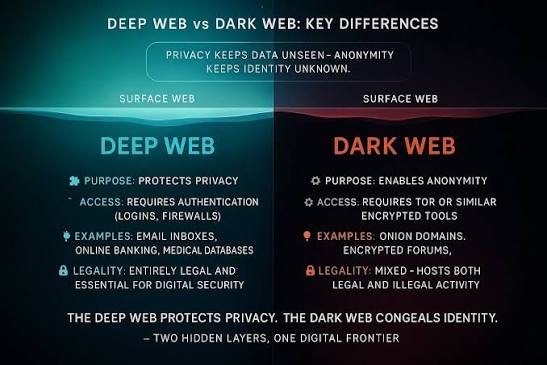
Introduction To Darkweb vs Deepweb Comparison
Many internet users encounter the terms darkweb vs deepweb comparison and assume they describe the same thing. In reality, they represent different parts of the online ecosystem. Confusion often arises because both exist outside traditional search engine visibility. However, their purpose, accessibility, and associated risks differ significantly. To understand better, please checkout onion links vs clearnet
A proper darkweb vs deepweb comparison helps separate common myths from reality. While the deep web contains everyday resources such as private databases, subscription services, academic archives, and corporate portals, the dark web represents a smaller segment that requires specialized software like Tor for access.
For more insight, please explore dark web research and dark web & darknet differences
Understanding these distinctions is important for researchers, cybersecurity professionals, journalists, and curious internet users. By examining how each environment functions, users can better understand internet architecture, online privacy, information accessibility, and the challenges associated with hidden online content.
What Is the Deep Web?
The deep web refers to all internet content that search engines cannot index directly. Contrary to popular belief, the deep web is not inherently secretive or criminal. In fact, most internet users access deep web resources every day without realizing it.
Examples include online banking portals, medical records, university databases, cloud storage platforms, subscription content, private company networks, and password-protected websites. These resources remain inaccessible to search engine crawlers because they require authentication or specific permissions.
A useful darkweb vs deepweb comparison begins by recognizing the immense size difference between the two. The deep web represents the majority of online content. Search engines index only a fraction of the internet, while vast amounts of information remain hidden behind login systems and restricted databases.
The purpose of the deep web is often practical rather than anonymous. Organizations use access controls to protect sensitive information, maintain privacy, and secure proprietary data. Consequently, most deep web content supports legitimate business, educational, healthcare, and governmental functions.
Because users interact with these resources daily, the deep web should be viewed as a normal and essential component of internet infrastructure rather than something mysterious.
What Is the Dark Web?
The dark web occupies a smaller subset of the deep web. Unlike password-protected websites, dark web services intentionally operate through anonymity-focused networks such as Tor. Access typically requires specialized software that routes traffic through multiple encrypted relays.
In a darkweb vs deepweb comparison, the dark web stands apart because of its emphasis on privacy and anonymity. Hidden services use unique onion addresses rather than conventional domain names. This architecture helps conceal server locations and user identities.
Although media coverage often focuses on illegal activity, the dark web serves several legitimate purposes. Journalists use anonymous communication platforms. Whistleblowers share sensitive information securely. Activists operating under restrictive governments may access uncensored information and communicate safely.
To understand better, please review onion site indexing methods.
At the same time, anonymity can attract malicious actors. Therefore, the dark web includes both lawful and unlawful content. Understanding this balance is essential when evaluating its role within the broader internet ecosystem.
Rather than viewing the dark web solely through a criminal lens, it is more accurate to see it as a technology-driven environment designed around privacy, anonymity, and censorship resistance.
Darkweb vs Deepweb Comparison: Key Differences
Accessibility
The most obvious distinction involves access methods. Deep web resources generally require credentials, subscriptions, or permissions. Standard web browsers can access them after authentication.
By contrast, dark web resources require specialized tools such as Tor Browser. Users cannot access onion services directly through conventional browsing methods.
Purpose
Another major difference concerns intended use. Deep web resources protect information through restricted access. Their goal is privacy and security for authorized users.
The dark web focuses on anonymity. Both users and website operators often seek identity protection, making anonymity a central feature.
Visibility
In a comprehensive darkweb vs deepweb comparison, visibility also matters. Search engines may know deep web resources exist even if they cannot access them. Dark web services often remain entirely hidden from traditional indexing systems.
Risk Profile
Deep web environments generally present lower risks because they operate within controlled access systems. Dark web environments may expose users to scams, malicious content, and fraudulent services if proper precautions are not taken.
These distinctions demonstrate that the two environments serve fundamentally different functions despite sharing the characteristic of limited search engine visibility.
Privacy, Security, and User Intent
Privacy motivations differ significantly between the deep web and dark web. Organizations use deep web technologies primarily to restrict access to authorized individuals. Security measures protect customer information, intellectual property, and confidential records.
The dark web, however, places anonymity at the center of its design. A thoughtful darkweb vs deepweb comparison reveals that users often access dark web services specifically to reduce identifiable digital footprints.
To explore further, please check Ahmia dark web search.
Privacy advocates frequently point to anonymity networks as tools that support free expression and protect vulnerable individuals. Meanwhile, cybersecurity experts emphasize the need for responsible use and awareness of potential risks.
For more insight, please explore Tor Project.
Users should also understand that anonymity does not guarantee safety. Strong operational security practices remain essential regardless of the environment being accessed. Downloading unknown files, sharing personal information, or interacting with unverified services can create risks even when anonymity technologies are used.
Therefore, informed behavior remains one of the most important factors in maintaining online security.
Common Misconceptions About the Deep Web and Dark Web Comparison
Many misconceptions persist because the terms often appear interchangeably in media reports. One common myth suggests that the entire deep web contains illicit content. This claim is inaccurate because most deep web resources consist of legitimate services used daily.
Another misunderstanding involves scale. The dark web represents only a small portion of hidden internet content. The vast majority of non-indexed information belongs to the deep web rather than anonymous networks.
To learn more about this, please explore dark web search engines.
A further misconception assumes that all dark web activity is illegal. While unlawful services certainly exist, legitimate privacy-focused communities, secure communication platforms, and research resources also operate within anonymity networks.
Finally, some users believe anonymity tools guarantee complete protection. Security professionals consistently emphasize that technology alone cannot eliminate risk. User behavior remains a critical component of online safety.
Understanding these misconceptions helps create a more balanced and accurate view of both environments.
The Role of Search and Discovery
Search functionality differs significantly between the deep web and dark web. Deep web resources often require direct access through authenticated portals. Search engines generally cannot index content behind login systems.
The dark web presents a different challenge. Hidden services frequently change addresses, disappear, or restrict crawler access. Consequently, specialized search engines attempt to discover, categorize, and verify onion services.
A complete darkweb vs deepweb comparison must account for these differences in discoverability. Deep web resources typically prioritize controlled access, while dark web resources prioritize anonymity.
To get more context, please explore DuckDuckGo Tor search.
As search technologies continue evolving, both environments will remain important components of the broader internet. Their differences reflect distinct goals, user needs, and technological architectures rather than opposing concepts.
FAQ To Darkweb vs Deepweb Comparison
What is the difference between the deep web and the dark web?
The deep web includes content that search engines cannot index, such as private databases and password-protected resources. The dark web is a smaller subset that requires specialized software like Tor for access. While both exist outside traditional search visibility, their purposes differ significantly.
Is the dark web part of the deep web?
Yes. The dark web exists within the broader deep web ecosystem. However, not all deep web content belongs to the dark web. Most hidden internet resources consist of legitimate databases, portals, and restricted-access services.
Is accessing the dark web illegal?
Accessing the dark web is generally legal in many jurisdictions. Legality depends on user activities rather than the technology itself. Many individuals use anonymity networks for privacy, journalism, research, and secure communications.
Why can’t search engines index deep web content?
Most deep web resources require authentication, subscriptions, or permissions. Search engine crawlers cannot access protected content without authorization. As a result, these resources remain outside standard search indexes.
Which is larger: the deep web or the dark web?
The deep web is dramatically larger. It includes countless databases, private systems, and restricted-access platforms used globally. The dark web represents only a small fraction of the hidden internet.
Conclusion To Darkweb vs Deepweb Comparison
A clear darkweb vs deepweb comparison reveals that these terms describe different layers of the internet. The deep web consists primarily of legitimate, non-indexed resources protected by access controls. The dark web represents a smaller anonymity-focused environment accessible through specialized networks such as Tor.
Although both exist outside traditional search engine visibility, their objectives differ considerably. Understanding these distinctions helps users separate myths from reality, evaluate online privacy technologies more accurately, and develop a more informed perspective on how the modern internet operates.