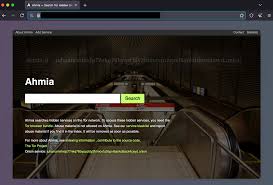
To understand about ahmia dark web search engine better, bear in mind that the hidden side of the internet does not operate like Google, Bing, or DuckDuckGo. Instead, most Tor-based websites appear briefly, change addresses often, and intentionally resist indexing. Because of this instability, people cannot browse onion services the same way they explore the surface web.
For that reason, specialized tools exist to support discovery inside hidden networks. One of the most widely referenced tools today is Ahmia dark web search — a research-oriented search engine built to index onion services and bring limited structure to an environment designed to avoid it.
In this guide, you will learn how Ahmia works, why it was created, how it differs from other onion search tools, and how professionals use it responsibly. More importantly, this article explains where Ahmia helps, where it falls short, and why onion indexing remains one of the most difficult challenges in hidden-network research. For more insight, see article on Torch dark web search, Haystak search engine overview and privacy-focused alternatives like DuckDuckGo
What Ahmia Dark Web Search Is and Why It Exists
Ahmia is a Tor-accessible search engine that focuses on discovering, indexing, and categorizing onion services. Rather than attempting to map the entire dark web, it concentrates on visibility, filtering, and long-term research value.
Its primary goals include:
• Supporting discovery of onion services
• Reducing exposure to harmful material
• Providing structured data for research
• Preserving access when sites frequently disappear
Because Tor services constantly move or vanish, traditional indexing methods fail. As a result, Ahmia was built around a controlled, research-driven model instead of a fully automated crawler.
To understand Ahmia’s role clearly, it helps to first understand how dark web search engines work, how onion search engines index sites and research-oriented onion indexing across the broader ecosystem.
How Ahmia dark Web Search Indexes Onion Services
Unlike surface-web search engines, Ahmia blends multiple discovery methods instead of relying on one system alone.
In practice, its indexing approach combines:
• Known onion network crawling
• Manual and verified submissions
• Uptime and stability tracking
• Category-based filtering
• Removal of obvious scam clusters
Rather than ranking sites by popularity, Ahmia emphasizes persistence, transparency, and research relevance. Consequently, its index often reflects infrastructure trends instead of raw volume.
In addition, Ahmia maintains a surface-web mirror. This allows researchers to study onion indexing without immediately connecting to the Tor network. As a result, universities and cybersecurity teams often use Ahmia as an observational platform before engaging with Tor directly.
How Ahmia Differs From Other Onion Search Engines
Although many onion search tools exist, they rarely serve the same purpose.
Some engines focus on:
• Aggressive crawling
• Maximum link volume
• Minimal filtering
• Automated indexing
By contrast, Ahmia emphasizes:
• Curated visibility
• Content filtering
• Research usability
• Infrastructure analysis
This difference becomes especially clear when examining older onion indexes. Many of them accumulate dead links, scam mirrors, and abandoned services. Over time, those directories lose research value.
If you are interested in how discovery tools evolved, Torbbb’s breakdown of the evolution of dark web search engines and dark web search evolution explains why controlled indexing has become the modern standard.
What Ahmia Shows — and What It Intentionally Avoids
Ahmia does not aim to present a complete snapshot of Tor. Instead, it attempts to filter large portions of the ecosystem to reduce risk and improve research quality.
Typically, Ahmia works to exclude:
• Violent content
• Exploitation material
• Scam-heavy clusters
• Obvious criminal marketplaces
Instead, its index often surfaces:
• Research communities
• Privacy tools
• whistleblower platforms
• academic mirrors
• historical Tor projects
• cybersecurity resources
Because of this filtering, Ahmia appeals strongly to journalists, analysts, and students. Rather than offering random exposure, it provides a structured starting point.
If your interest lies in how communities differ from markets, the comparison between darknet forums vs marketplaces and Ahmia compared with Haystak clarifies how information and influence move inside hidden networks.
How to Use Ahmia Safely and Effectively
Although Ahmia filters many categories, Tor browsing still carries technical and psychological risks. Therefore, responsible research habits matter.
When professionals use Ahmia, they usually:
• Access Tor through the official Tor Browser
• Limit scripts and plugins
• Avoid interacting with unknown services
• Never submit personal information
• Treat all listings as unverified
More importantly, experienced users approach onion discovery as observation rather than participation.
For a broader safety framework, Torbbb’s guide on safe dark web browsing tips and indexing onion services tied to payments explains how researchers reduce digital exposure and behavioral risk.
Why Researchers Rely on Ahmia
Because onion services vanish quickly, Ahmia provides something rare inside Tor: continuity.
Specifically, it helps analysts:
• Observe infrastructure changes
• Track forum and service migration
• Monitor scam network behavior
• Study ecosystem rebuilding
• Identify emerging privacy projects
After law-enforcement actions or major shutdowns, discovery tools become especially valuable. When markets or forums disappear, researchers use indexes like Ahmia to watch what replaces them.
If you’re studying those shifts, Torbbb’s breakdown of darknet market shutdown patterns shows how hidden economies reorganize.
Limitations and Common Misconceptions to Ahmia dark Web Search
Despite its value, Ahmia is often misunderstood.
It is not:
• a complete index
• a verification system
• a live directory
• a safety guarantee
Instead, Ahmia functions as a continuously maintained research lens.
Because onion services resist permanence, every index begins decaying the moment it is created. New services appear. Old ones vanish. Scam mirrors multiply rapidly. As a result, Ahmia’s strength lies in pattern visibility rather than accuracy.
Understanding this distinction prevents one of the most common beginner mistakes: treating any onion search engine as authoritative.
This is also why investigations into darkweb vendor trust emphasize long-term behavior over directory listings.
Ahmia’s Role in Modern Dark Web Research
Today, Ahmia operates as part of a broader intelligence ecosystem.
Its data supports:
• academic studies
• cybersecurity monitoring
• investigative journalism
• threat-intelligence platforms
• policy research
In practice, researchers combine Ahmia’s index with forum monitoring, infrastructure mapping, and leak-site observation. Together, these layers produce a more accurate view of hidden networks.
Trusted Sources and External References
For deeper background and verified research perspectives, these organizations provide essential context:
Tor Project – Official documentation on onion services
Electronic Frontier Foundation – Research on anonymity networks
Europol – Public reporting on hidden-service crime ecosystems
BleepingComputer – Investigative coverage of dark web infrastructure
Frequently Asked Questions
Is Ahmia illegal to use?
No. Ahmia itself is a research-oriented search engine. However, responsibility depends on which services a user accesses.
Does Ahmia index everything on Tor?
No. It intentionally filters and curates its listings.
Can Ahmia verify onion services?
No. It indexes services but does not authenticate them.
Is Ahmia safer than random directories?
Generally yes, because it removes many scam clusters. However, no onion index eliminates risk.
Do professionals rely on Ahmia?
Yes. Journalists, researchers, and cybersecurity teams frequently use Ahmia alongside other monitoring tools.
Conclusion to Ahmia dark Web Search Engine
Ahmia dark web search exists to address a structural problem: discovery inside unstable networks.
Rather than offering a map, Ahmia provides a research lens. It helps observers track patterns, monitor shifts, and study how onion services evolve over time. When used responsibly, it supports investigation, education, and digital safety. When misunderstood, it creates false confidence.
Ultimately, Ahmia reinforces a central truth of hidden networks: the dark web cannot be indexed like the surface web. It can only be observed.