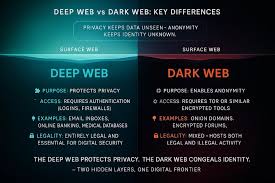
To be clear on the key differences between the dark web vs deep web comparison, you must know that the internet most people use every day represents only a small fraction of what actually exists online. While search engines surface billions of pages, a much larger portion of online content lives beyond public indexing. This reality often fuels confusion, especially when people encounter the terms “deep web” and “dark web” used interchangeably.
However, understanding the dark web vs deep web comparison starts with separating technical structure from popular myth. Although both exist beyond standard search engines, they serve very different purposes, operate on different systems, and carry very different risk profiles.
This guide breaks down how each layer works, why they are frequently misunderstood, and how researchers, journalists, and analysts distinguish between them in real investigations. For more insight, explore how DuckDuckGo fits into Tor browsing and how dark web payments differ from the deep web
The Surface Web: The Smallest Layer People See
Before exploring hidden layers, it helps to understand what they are not.
The surface web includes any content indexed by traditional search engines such as Google, Bing, or DuckDuckGo. News sites, blogs, ecommerce stores, social networks, and corporate pages all belong here. These sites rely on open protocols that allow automated crawlers to map, rank, and display their content.
However, this public layer represents only a thin skin over a much larger infrastructure. Once pages block crawlers, require logins, or sit behind private systems, they disappear from public indexing entirely.
As a result, the moment content becomes inaccessible to search bots, it moves into what is commonly called the deep web.
What the Deep Web Actually Is
The deep web consists of any online content that search engines cannot index. Importantly, most deep web content is ordinary, legal, and widely used.
For example, the deep web includes:
- Email inboxes
- Cloud storage dashboards
- Online banking portals
- Medical record systems
- Academic databases
- Private company intranets
- Subscription-only platforms
In other words, the deep web forms the backbone of daily internet activity. Every time you log into a service, you access deep web infrastructure.
Because of this, the deep web does not hide itself. Instead, it protects access through authentication, paywalls, or private servers.
Therefore, when people hear “deep web,” they are usually interacting with it constantly—just without realizing it.
What Makes the Dark Web Different
The dark web, by contrast, refers to networks that intentionally conceal both users and servers. Rather than sitting behind logins, dark web services run on encrypted overlay networks such as Tor or I2P.
These systems route traffic through multiple encrypted nodes, preventing observers from easily identifying who is accessing a site or where the site is hosted.
Because of this design, dark web services:
- Do not use standard domains
- Do not rely on public DNS
- Cannot be indexed reliably
- Change addresses frequently
- Require specialized software
Most commonly, users access them through the Tor Browser.
To understand how these environments evolve, researchers often track active darkweb markets and services that reorganize after takedowns, scams, and law-enforcement operations.
Structural Differences at a Glance
Although both layers remain invisible to search engines, they differ fundamentally.
Deep web content hides behind access controls. Dark web content hides its existence itself.
Deep web systems support stability, privacy, and commerce. Dark web systems prioritize anonymity, deniability, and resistance to surveillance.
As a result, the dark web vs deep web comparison revolves less around visibility and more around architecture.
In the deep web, you log in to known systems.
On the dark web, you enter unknown territory.
Why Search Engines Cannot Map the Dark Web
Traditional crawlers rely on stable links, open ports, and predictable server behavior. Dark web networks disrupt all three.
Onion services often block automated scanning, rotate addresses, and disappear without warning. Additionally, many services actively defend against indexing to avoid exposure.
Because of this instability, even specialized crawlers struggle to maintain accurate datasets. Analysts therefore rely on layered approaches that combine crawling, human verification, and community monitoring.
For anyone studying hidden ecosystems, a structured darkweb monitoring guide and commercial activity on the dark web becomes essential for separating genuine activity from recycled noise.
Content Differences Between the Deep Web and Dark Web
Another important distinction lies in content composition.
Deep web platforms host personal, financial, academic, and enterprise data. Their users generally know where they are and why they are there.
Dark web platforms, however, host a volatile mix of:
- Privacy forums
- Whistleblower drop sites
- Independent journalism hubs
- Cryptocurrency services
- Marketplaces
- Scam networks
- Data leak repositories
This volatility explains why darknet content constantly fragments and re-forms. After shutdowns, communities migrate, vendors resurface, and clones multiply.
Consequently, dark web ecosystems behave more like shifting populations than fixed websites.
Trust, Fraud, and Behavioral Risk
While the deep web relies on institutional trust systems, the dark web replaces them with informal reputation layers.
Vendors attempt to build credibility. Forums attempt to moderate. Marketplaces attempt to enforce escrow. Yet none of these systems offer long-term guarantees.
Because of this, manipulation thrives.
Understanding fraud patterns therefore requires studying behavioral signals, not just technical indicators. Research into the psychology of darkweb scams shows how social engineering, urgency, and perceived authority repeatedly drive user losses.
Directories, Lists, and the Illusion of Mapping
Beginners often search for “lists” of dark web sites. However, reliable mapping remains impossible.
Most directories rely on user submissions, mirrors, and scraped references. Over time, dead links accumulate while fake ones proliferate.
Although some platforms attempt verification, even verified darkweb directories become outdated quickly due to infrastructure churn.
For this reason, professionals treat directories as discovery tools, not navigational maps.
The Role of Darknet Marketplaces
Media coverage frequently associates the dark web with crime. While illegal commerce does exist, it represents only one layer of a broader ecosystem.
Nevertheless, monitoring darknet marketplaces offers analysts measurable insight into technological shifts, security adaptations, and enforcement impact.
Market behavior often reveals:
- New encryption practices
- Payment evolution
- Scam emergence
- Community migration
- Operational tradecraft
Because of this, researchers examine markets less as stores and more as intelligence signals.
Vendor Reputation and Trust Systems
Unlike surface platforms that enforce identity, dark web services operate on pseudonymity. Vendors therefore rely on review systems, escrow histories, and forum presence to establish legitimacy.
However, these systems remain fragile. Exit scams, impersonation, and fabricated histories frequently undermine them.
Studying darkweb vendor trust reveals how reputation itself becomes a tradable commodity in anonymous economies.
Legal and Ethical Oversight
International agencies increasingly monitor dark web activity, not to map everything, but to detect high-risk threats.
Europol, for example, routinely publishes intelligence on dark web market disruptions and cybercrime investigations.
Similarly, the Electronic Frontier Foundation documents the legal, technical, and ethical implications of privacy networks.
Meanwhile, the Tor Project provides transparent documentation on how onion routing works and why anonymity tools serve legitimate civil-rights purposes.
FAQs: Dark Web vs Deep Web
Is the deep web illegal?
No. Most deep web content supports everyday services such as banking, healthcare, and education.
Is the dark web always criminal?
No. While illicit activity exists, journalists, activists, and researchers also use dark web platforms for privacy and protection.
Can Google index either?
Google indexes surface content only. Both deep and dark web content fall outside standard indexing models.
Do you need Tor for the deep web?
No. You access the deep web every time you log into a private account.
Do you need Tor for the dark web?
Yes. Onion services require Tor or compatible networks.
Conclusion: Why the Difference Matters
The dark web vs deep web comparison is not about fear. It is about architecture.
The deep web protects access.
The dark web conceals existence.
Understanding this distinction prevents misinformation, clarifies investigative reporting, and supports safer research practices. While both layers operate beyond search engines, only one intentionally resists visibility at the network level.
Recognizing how these environments function helps users, journalists, and analysts navigate hidden systems without importing surface-web assumptions into fundamentally different spaces.